


Syllabus: GS2/IR; GS3/Economy
Context
- India and New Zealand signed the India- New Zealand Free Trade Agreement (IN- NZ FTA).
About
- The India–New Zealand Free Trade Agreement was concluded in nine months and marks a key milestone in India’s engagement with developed economies.
- India is signing its seventh FTA in the last three and a half years, with plans for agreements with the European Union and the United States, taking the total to nine FTAs with 38 advanced economies, covering nearly 65–70% of global GDP.
What is a Free Trade Agreement (FTA)?
- A Free Trade Agreement (FTA) is a pact between two or more countries where they agree to:
- Reduce or eliminate customs duties on goods;
- Liberalise trade in services;
- Provide investment protection;
- Ensure safeguards for intellectual property rights (IPR).
Major Highlights of the FTA
- Zero-Duty Market Access: India- New Zealand FTA eliminates duty on 100% of Indian Exports.
- India has offered market access in 70.03% of the tariff lines while keeping 29.97 % tariff lines in exclusion.
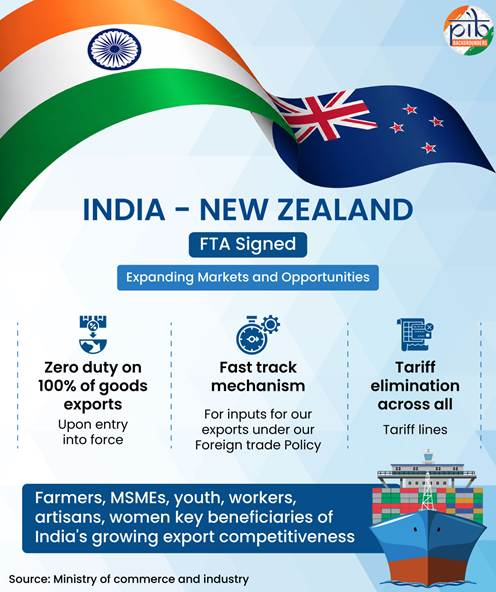
- FDI Commitment: New Zealand will invest USD 20 billion in India over 15 years, strengthening long-term economic ties.
- Organic Primary Products: Mutual recognition of organic certification to be agreed between the two sides.
- MSME Cooperation: Institutional linkages to help small businesses access trade-related information and global markets.
- Technical Assistance: Cooperation has been agreed in AYUSH, audio visual industries, tourism, sports and traditional knowledge systems.
- The FTA promotes India’s AYUSH systems internationally, encourages medical value travel, and positions India as a global wellness hub.
- MFN Treatment: Commitment across 118 services sectors, with Most-Favoured Nation (MFN) treatment in 139 sectors.
- Student Mobility: New Zealand signed Annex on Student Mobility and Post Study Work Visa for the first time with any country.
- Indian students can work up to 20 hours per week while studying, even if there are policy changes in future, with extended post-study work visas (STEM Bachelor: 3 yrs; Master’s: up to 3 yrs; Doctorate: up to 4 yrs).
- Professional Pathways: A quota of 5,000 visas for skilled Indians for stay upto 3 years in the sectors of interest to India.
- Working Holiday Visa: 1,000 young Indians annually can avail multiple entry in New Zealand for a period of 12 months.
- Certain products are kept in exclusion from the dairy and agriculture sector of India, which is a huge win for labour intensive sectors.
- Dairy, animal products, vegetable products, sugar, artificial honey, Animal, vegetable or microbial fats and oils, Arms and Ammunition, Gems and Jewellery, Copper and Articles, Aluminium and articles.
Significance to India from FTA
- The India–New Zealand FTA secures duty free or preferential access across a wide range of sectors.
- These gains are expected to boost India’s exports, create jobs, and strengthen the competitiveness of Indian industries in the Oceania region.
- Dedicated cooperation in Ayush and Indian traditional knowledge has been agreed.
- Engagement with New Zealand’s indigenous Maori communities to promote cultural exchange and mutual respect. This strengthens India’s soft power and global recognition of its heritage.
- Gains in Horticulture Sector: New Zealand has agreed on focused Action Plans for kiwifruit, apples, and honey to improve productivity, quality, and sectoral capabilities of these fruits growers in India.
- Projects for premium apple cultivators and sustainable beekeeping practices will enhance production and quality standards.
- This access will be managed through a Tariff Rate Quota (TRQ) system with Minimum Import Price and seasonal imports, ensuring consumer choice while protecting domestic farmers.
India-NZ Bilateral Ties
- Currently, New Zealand is India’s second-largest trading partner in Oceania.
- In 2024, New Zealand’s imports stood at USD 47 billion, while exports were USD 42 billion.
- Services Trade: India’s services exports to New Zealand grew by 13% in 2024, reaching USD 634 million. Major sectors include travel, IT, and business services.
- In 2024-25, the exports from India to New Zealand were higher than imports from New Zealand, maintaining a positive trade balance with the country.
Conclusion
- The India–New Zealand Free Trade Agreement opened new avenues for comprehensive economic cooperation.
- From farmers and MSMEs to students and skilled professionals, the gains from this Agreement are expected to be broad-based.
- It reinforces India’s position as a trusted, forward-looking global partner and advances the vision of a globally integrated Viksit Bharat 2047.
Source: PIB
Previous article
News In Short 27-04-2026
Next article
China surpasses US in Research Spending
